


Red Bull’s joint team launch in Detroit was, as usual from them, a spectacular one, but aside from the liveries and power unit chat, we also got our first insight into the first two car concepts to differ from the generic FIA renders we’ve seen so far.
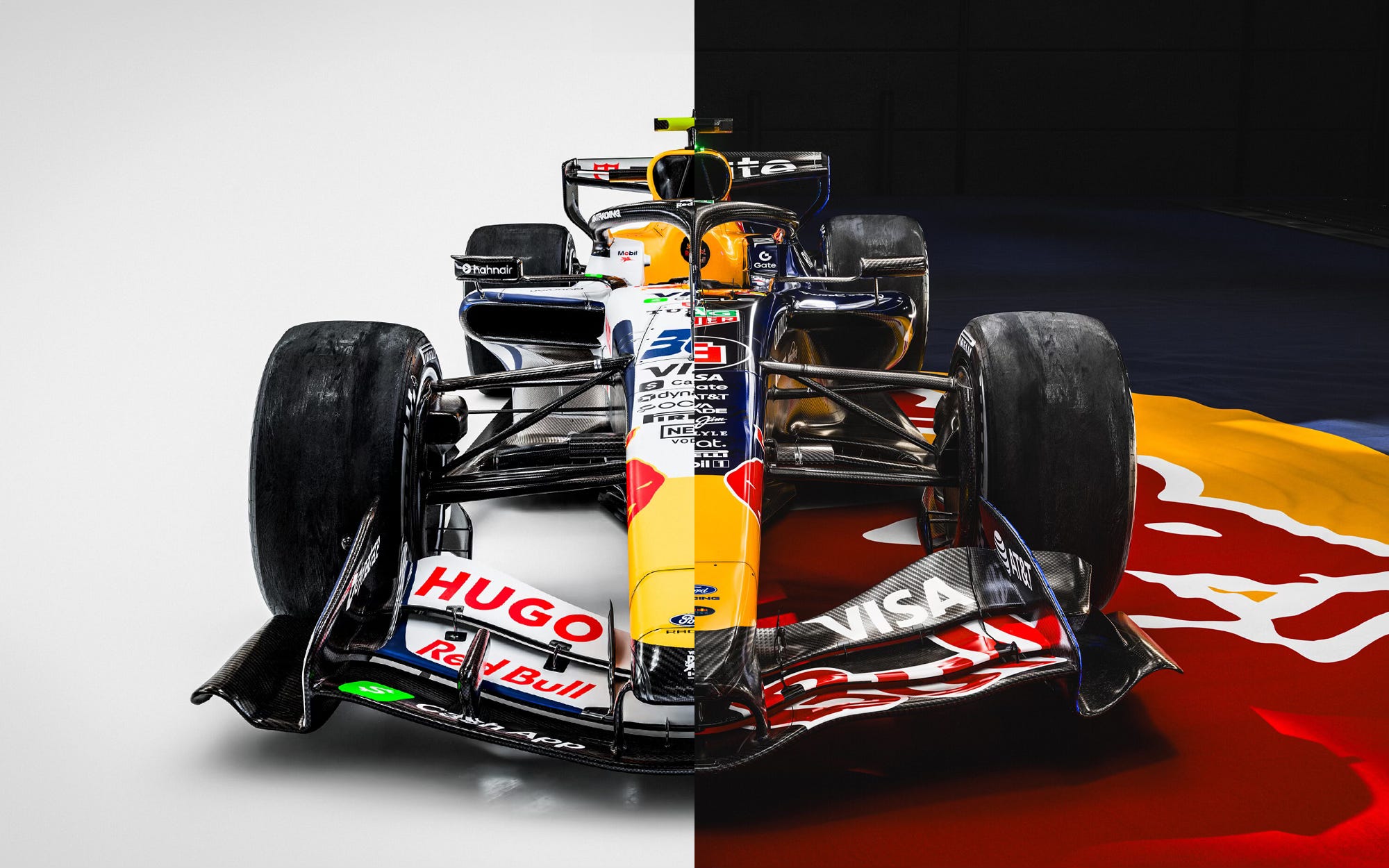
While they themselves are still renders and will likely be completely different to the RB22s or VCARB03s we see hit the track at pre-season testing, and again by the first race in Australia, their differences are worth analysing.
Design variation was a huge theme of the last big regulatory shift in 2022 with a few central concepts arising over the teams, but each clearly following their own, unique interpretations of the rulebook at that early stage before the inevitable convergence to a single concept.
The evidence from Red Bull’s RB22 and how it compares to the VCARB03 indicates we’re in for a similarly diverse design pool this year, with the differences starting right at the front wing.
Active aero actuators
The first standout difference between the two cars is the clear presence of actuators on the front wing of the VCARB03, in what is our first look at how the active aerodynamics may function. Active aerodynamics will be absolutely central to this new era given that the cars will switch between ‘straight-line mode’ and ‘corner mode’ multiple times a lap, every lap, regardless of their proximity to other cars.
Though that may be the case, until this launch we were yet to see how the movement of the wing elements would be made possible, either through hydraulics or electronics. To this point, our only real insight into such systems were with a rather crude prototype actuator run by Mercedes at the post-season test or a more integrated, front wing flap adjuster-style system from Ferrari.
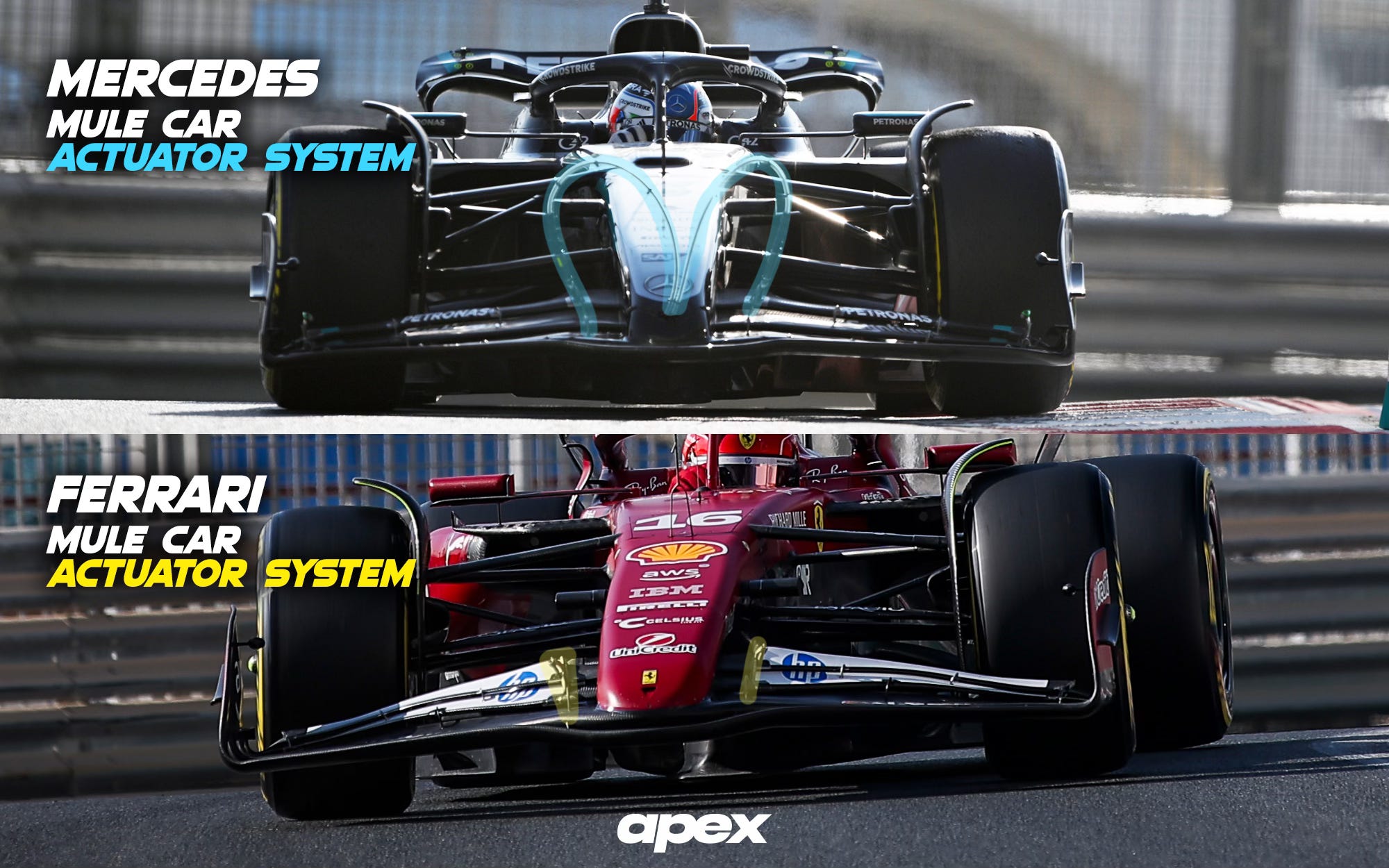
On the VCARB03 though, the system looks to take more of an old-DRS style approach which does appear fairly basic - perhaps hinting at these actuators being placeholders for a more integrated system. We can see that they connect to the lower-most moveable flap, yet given the connections between it and the upper-most one, it’s likely that this system would move both simultaneously.


The RB22 doesn’t feature these actuators, but under the nose there is an additional ‘stay’ which could house one central system that connects to both sides of the wing - a more sleek, integrated solution. The connections seen between the RB22’s front wing flaps mean we could assume the same level of functionality as the VCARB03, where both or neither flaps move.
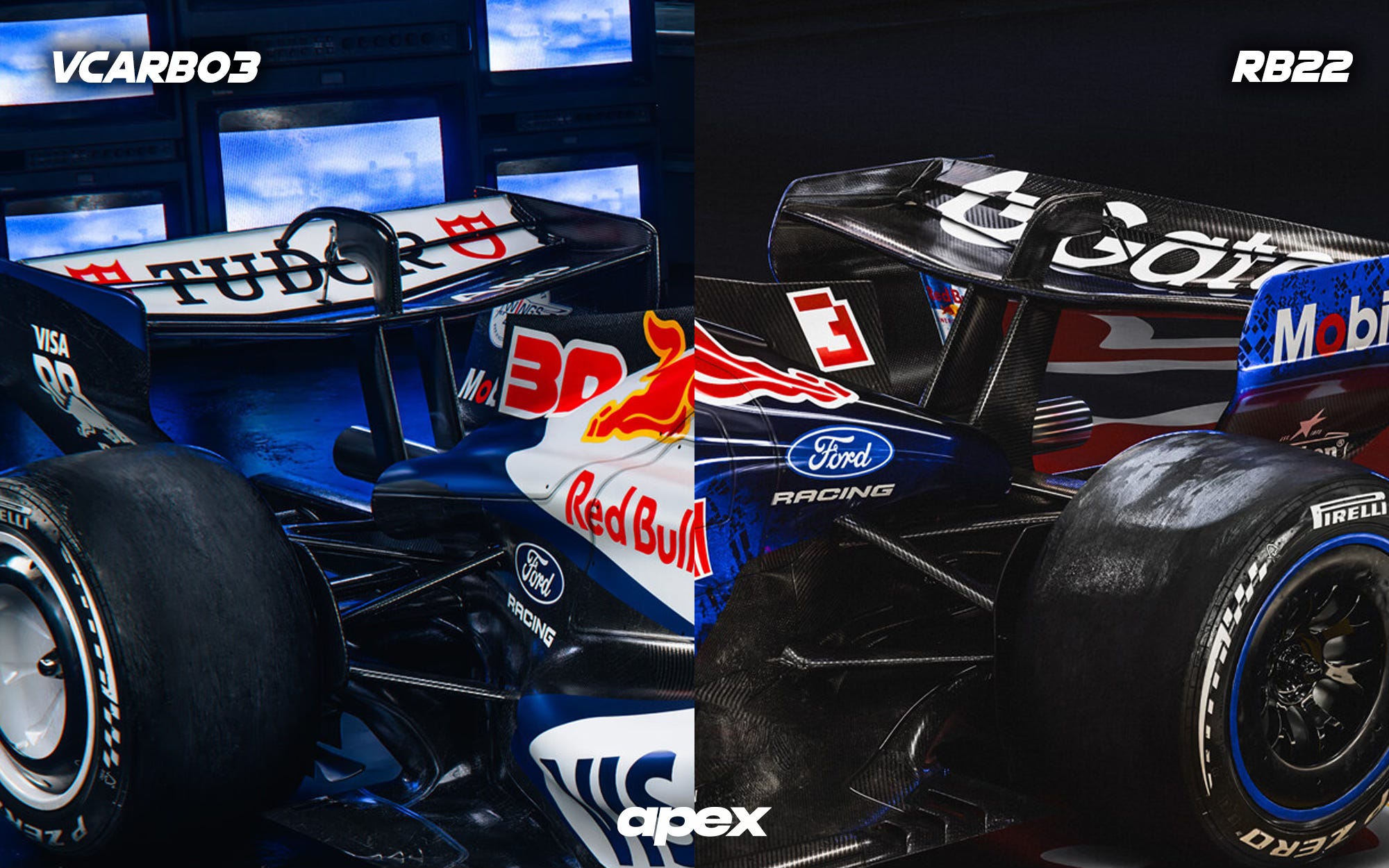
Looking to the rear wing of both cars there is just one connection from a single flap to one central actuator, very similar to DRS.
Front wing concepts
Even beyond the actuators and active aerodynamics clues, the front wings of the cars are distinctly unique. The RB22’s is more sculpted and curved with varied widths over the inboard to outboard length of the elements, particularly the upper-most one. On the VCARB03, these are more uniform.
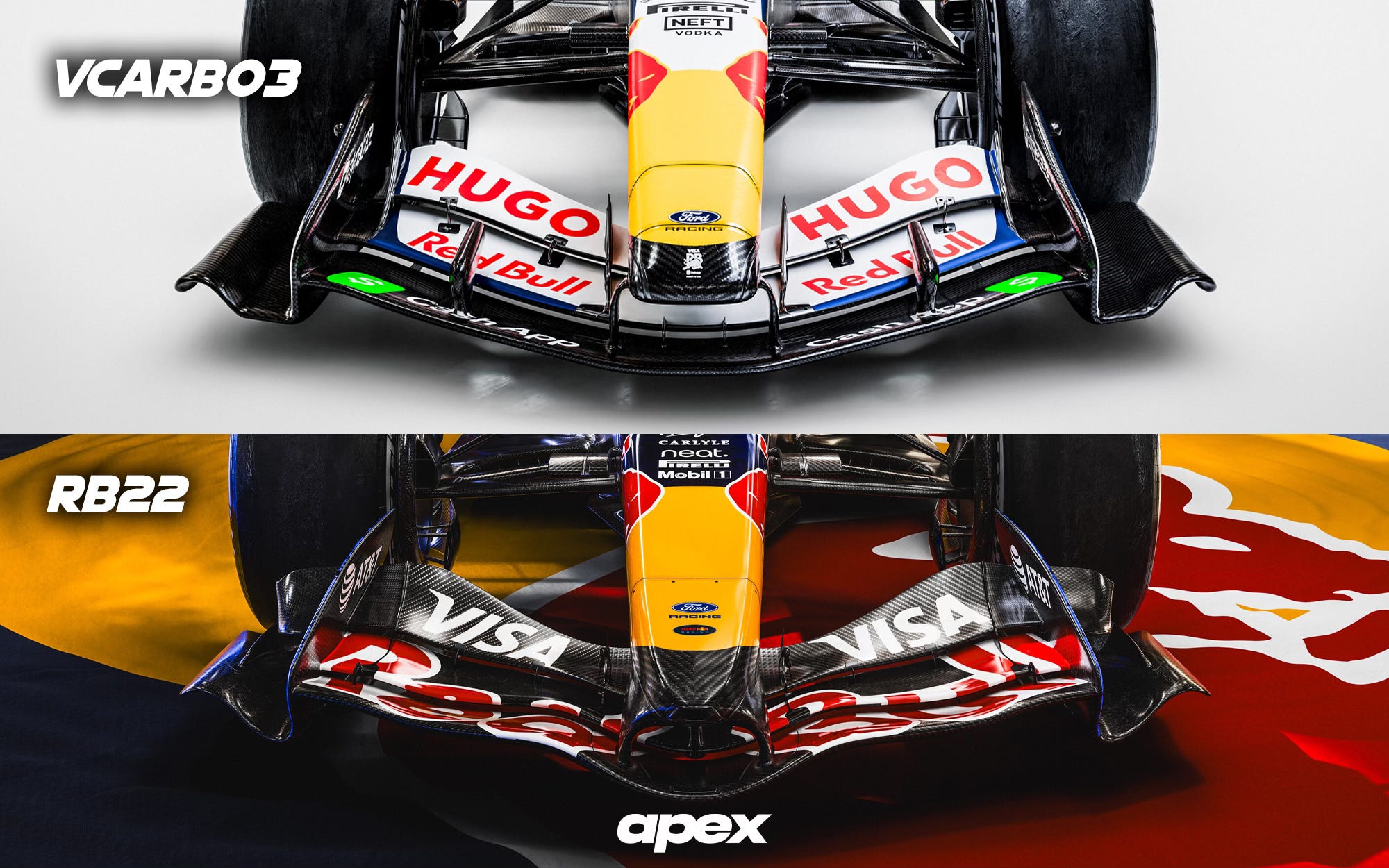
How the wing attaches to the nose is also different per car. Again the RB22 appears more developed and sculpted, particularly from a side-on view, but both join at the static lower element of the front wing, which is not part of the active aerodynamics system.
Even at the endplates, clear distinctions can be made between the two concepts with more complexity to the RB22’s over the VCARB03’s.
Bargeboards are back
Bargeboards, at least in a more simplistic form than when they were last seen in 2021, are back for this regulatory era - aimed at controlling wheel-wake and promoting in-wash.


In the renders we’ve seen to this point, these have been relatively simple devices sitting at the front of the floor, however Red Bull’s RB22 and Racing Bulls’ VCARB03 both have a new level of complexity to the vertical surface. There are three split horizontal elements there on both cars, compared to the solid surface seen on the FIA renders. How those connect to the front vertical element(s) differs, as does how that vertical element connects to the tray.
The VCARB03 has two vertical elements that look to overlap slightly, while the RB22 has a single more curved piece sitting on top of a flatter tray, as opposed to the continuation seen between these elements on the VCARB03.
The VCARB03 also has a stay to the chassis from the vertical element that isn’t seen on the RB22, nor any past FIA renders.
Sidepod differences
Where the differences between these early concepts really come to life is at the sidepods. Red Bull’s RB22 looks to almost be a continuation of the concept they ran over the modern ground effect era (2022-25) with an ‘overbite’ upper edge to the inlet, a tapered shape front to rear and an aggressive under cut that runs the length of the floor edge.
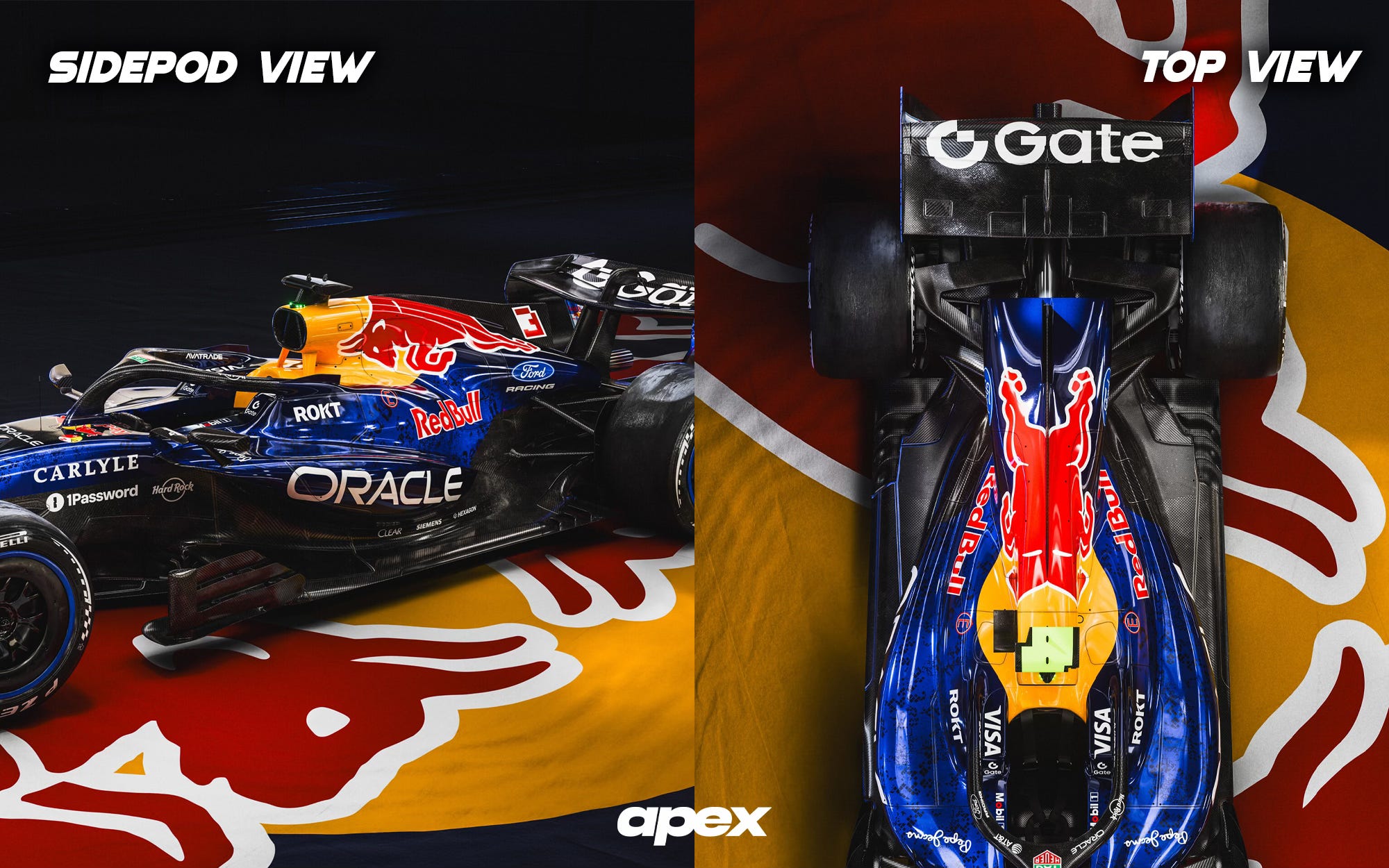
That undercut here generates a more exaggerated ‘coke bottle’ shape at the rear, with more exposed floor edge than we’ve seen on the past generation of car before it sculpts upwards and rearwards to the diffuser.
On the VCARB03, the sidepod inlets are much wider and more uniform in height across the width. That inlet shape then sculpts down the length of the sidepod itself, which has much less of an undercut to it than the RB22, almost forming a ‘boxier’ shape with a more distinct upper surface, not dissimilar to the ‘waterslides’ seen from 2022-25.
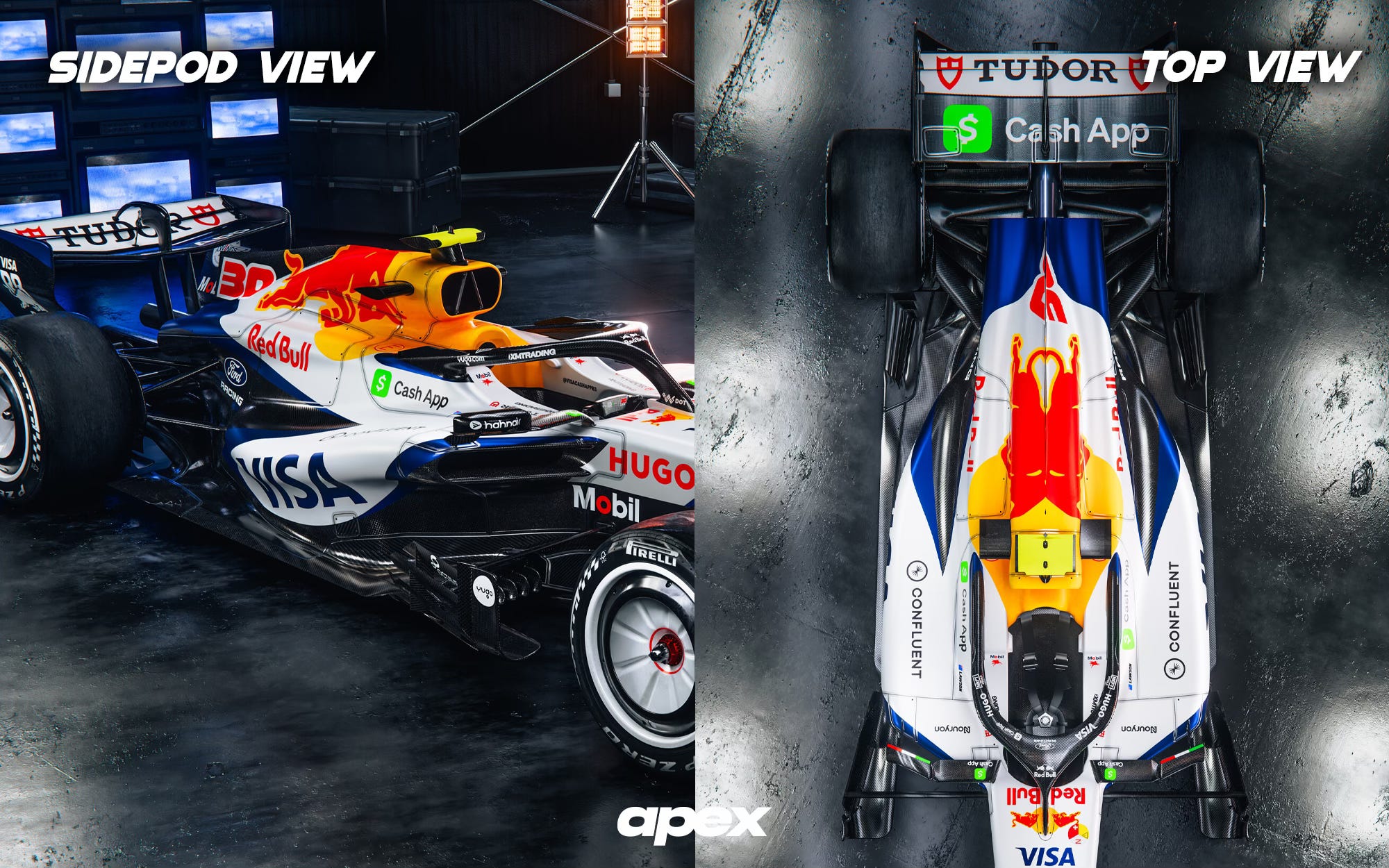
Rearwards, the result of that shape is less exposed flat floor edge, and less of an exaggerated coke bottle shape.
Wheel covers
Visually, the white wheel covers on the VCARB03 are incredibly eye catching but the design of them is comparable to one we saw Audi run at their shakedown in Barcelona.
Wheel covers became a consistent feature under the last regulation set starting in 2022, but before then hadn't been seen since 2009. The aim of their reintroduction was simple - to reduce the aerodynamic wake at the rear of the cars, helping them follow closer and making for better racing action.
But under the 2022-25 regulations, they were a ‘standard supply component’ meaning every team was supplied them identically from the FIA, created by a manufacturer called BBS on their behalf. For 2026, that’s no longer the case, and they’ve moved to be an ‘open source component’.
It means the teams can design them themselves, with the condition that all intellectual property and design specifications are made available to all F1 teams on an FIA specified server. By creating a new design, or modifying an existing one, the team grants every other team an “irrevocable, royalty-free, non-exclusive, worldwide license” to use and modify it themselves (as laid out in Article C17.5 of the Technical Regulations).
It means maintaining secrecy around an innovation in that area is not possible, and also that we’re likely to see the teams converge on a single design, or few designs, depending on what best suits their car and its wider aerodynamic concept.
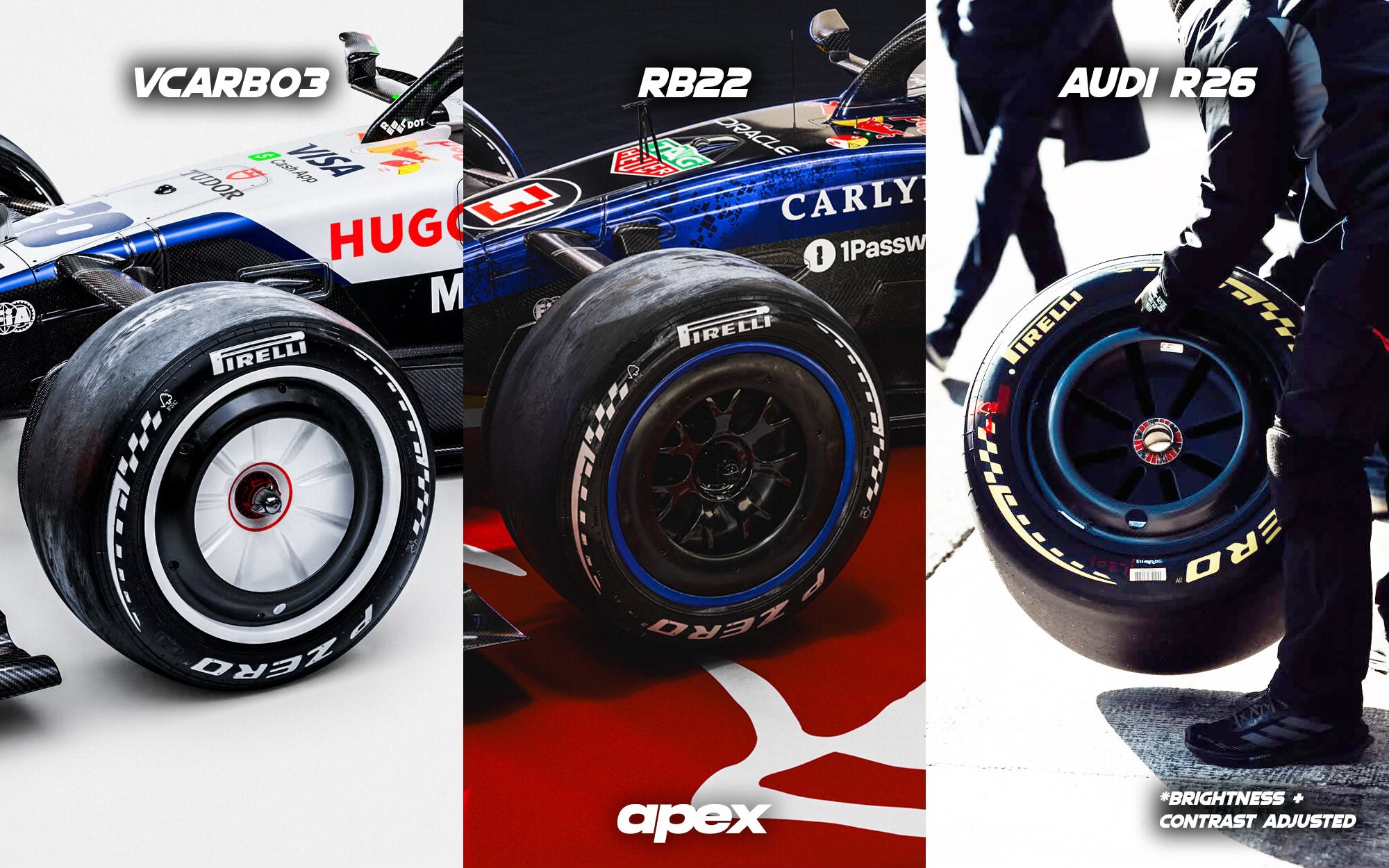
So far, between Audi and Racing Bulls, that takes the form of a flat covering over the wheel rims, set within an open, more curved, convex ring-shaped disc that sits more flush with the tyre. Red Bull have a similar, what the regulations call, “annular outboard disc”, albeit in a seemingly flatter, less convex shape, but they have retained an opening to the rims.
Whether these will change as the cars get out on track remains to be seen of course, but we’re starting to get a view as to the potential interpretations we could see of the more open regulations regarding wheel covers.
Subtle details
Beyond the most stark differences or similarities between these renders, there are more subtle ones too. The shark fin appearing on the rear of the engine cover of both the RB22 and VCARB03 is worth mentioning, as it’s something that’s consistent not only with the FIA’s own renders but also the imagery from Audi’s shakedown and now Cadillac’s too.


The mirror housings also hint at two of the likely many designs we’ll see over the grid, with Racing Bulls’ looking to be more or less a carryover from their 2025 car and that also looking to be the case for Red Bull.
Overall, of course there is more to come and this is very early days, but if these concepts hold in terms of their variation from each other even as they become more developed, there’s hope for more design diversity to come.