

Race Trace: Why Lewis' Barcelona win is the culmination of a joint journey back to the top
Lewis Hamilton is back on top, 686 days after his last win, but what's almost just as incredible is the initiative Ferrari took to make it happen.


Welcome to our first written version of Race Trace, where we review how pivotal races played out according to the data! Who else’s race in Barcelona could this edition focus on than Lewis Hamilton’s, not only because of his own magic, ‘vintage Hamilton’ performance, but because of Ferrari’s too.
Yes, that’s right, Ferrari’s strategy and handling of that race deserves recognition because, quite simply, it was impressive but also quite different for them in its level of initiative and aggression right from the off.
It’s rare to say, but they were the ones calling the strategic shots and leaving other teams to respond to them rather than the opposite that has so often been true. And that’s why it’s worth exploring how Lewis’ race played out in more, data-backed detail.
Lewis came into the race with exactly the same allocation as every other car starting in the top 5, except for Verstappen. He had two new sets of hards, one new medium and three used softs available, but the way Ferrari used them over the race was different and set up by the starting compound choice they made, a used soft.
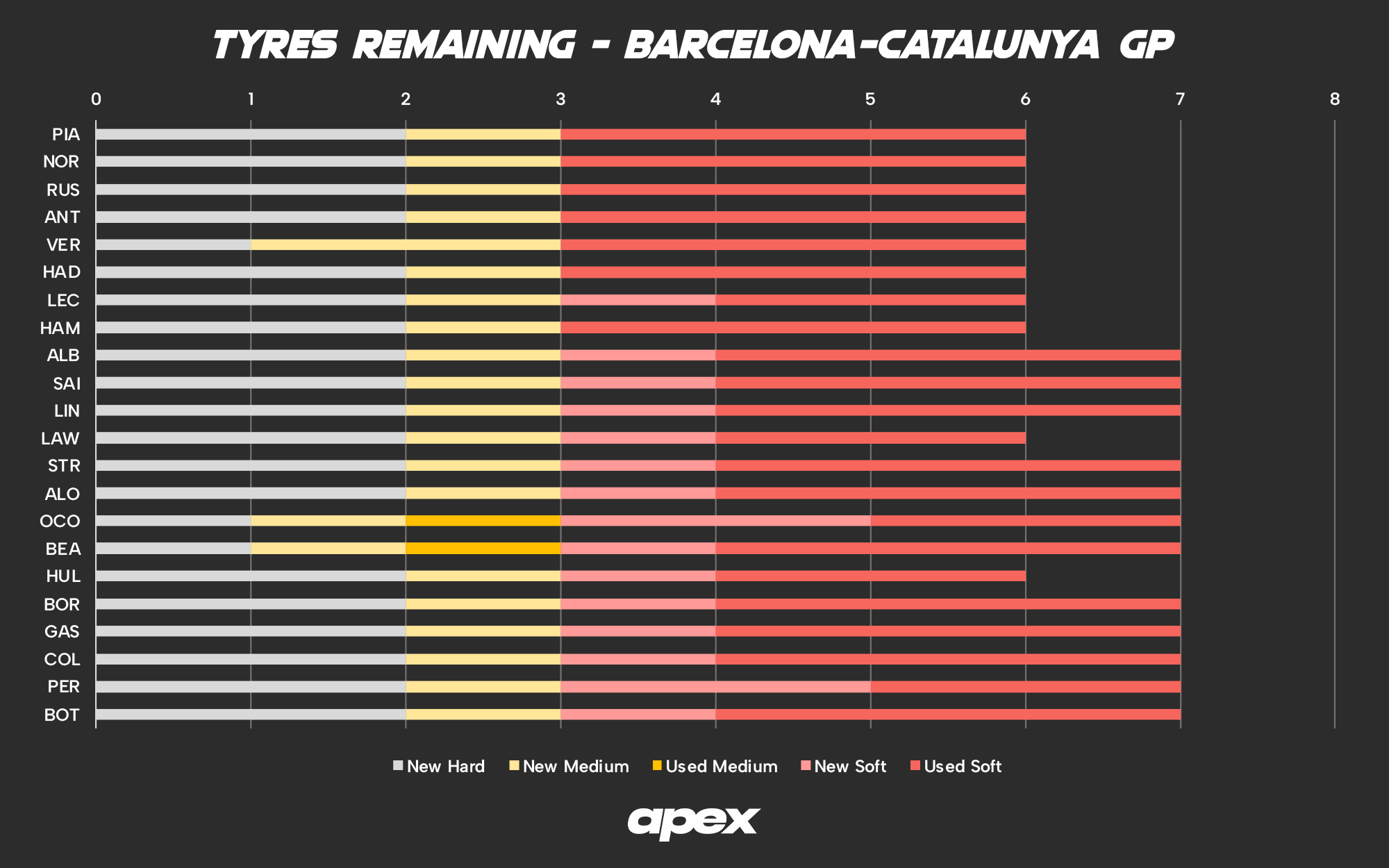
That was in direct contrast again with every car starting around him except for Verstappen, and near committed Hamilton to the three-stop right there and then because he would have to come in to box before the medium-starters and potentially force their hand - sign one of Ferrari taking strategic control.
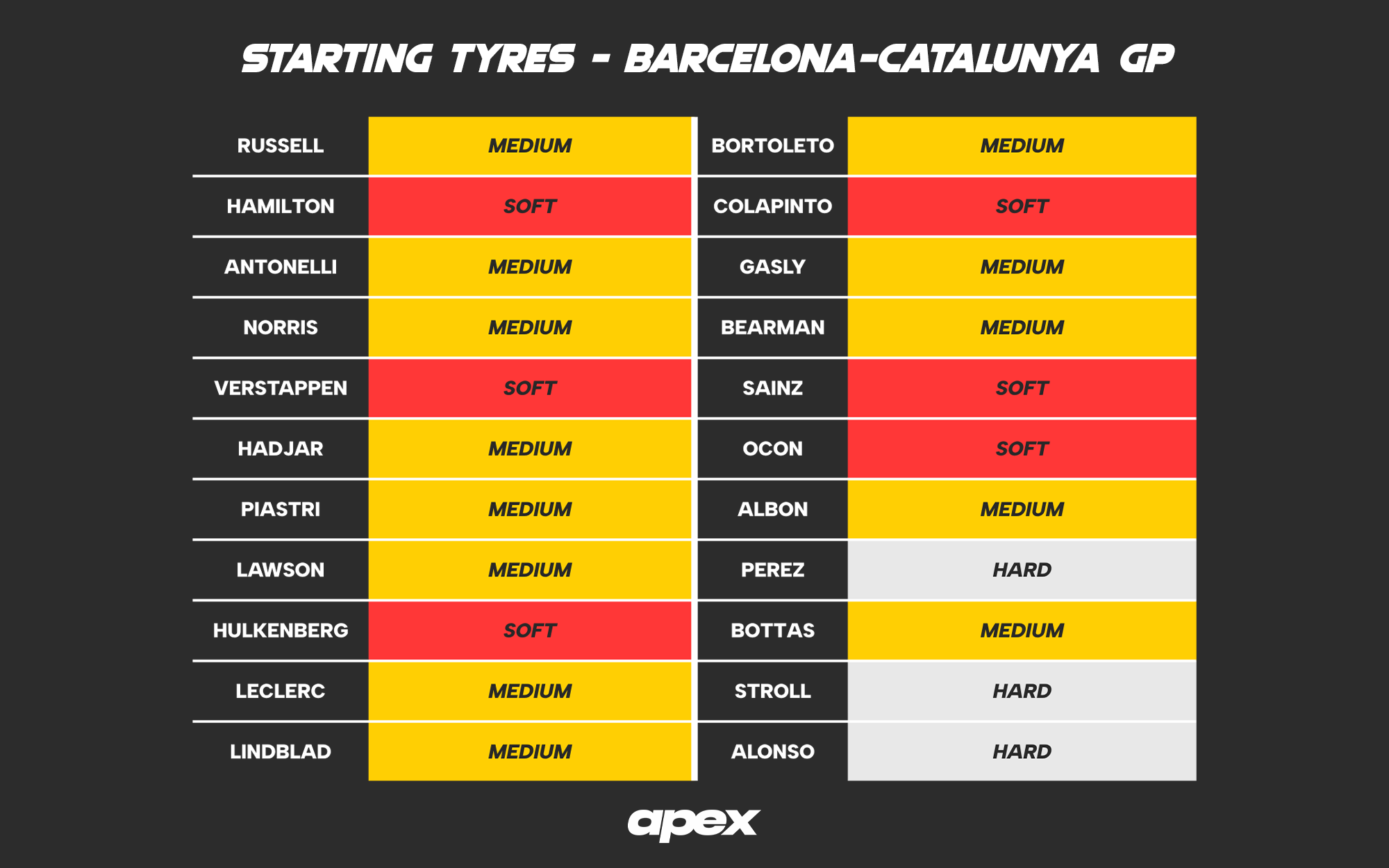
And that’s exactly how it played out.
George Russell was able to stick ahead from the start despite running a harder tyre than Lewis, but even with that medium tyre’s longer lifespan, Mercedes really had no choice but to respond when Lewis boxed for the first time on lap 12. That came down to the strength and potency of the undercut.
Where degradation is so high and so strong, as it proved to be yesterday on the soft and medium especially, the undercut becomes more powerful and the rival car has no real choice but to cover off the stop. Without doing so, the pace of the car that’s boxed first onto fresher tyres will be superior over its out-lap to the rival who’s remained on the older tyres.
George boxed on lap 13, one lap later, and was able to retain his net lead over Lewis by doing so. Norris followed suit a lap after that, and Antonelli then covered him off on lap 15 - putting all four of the net top four cars onto the hard tyre.
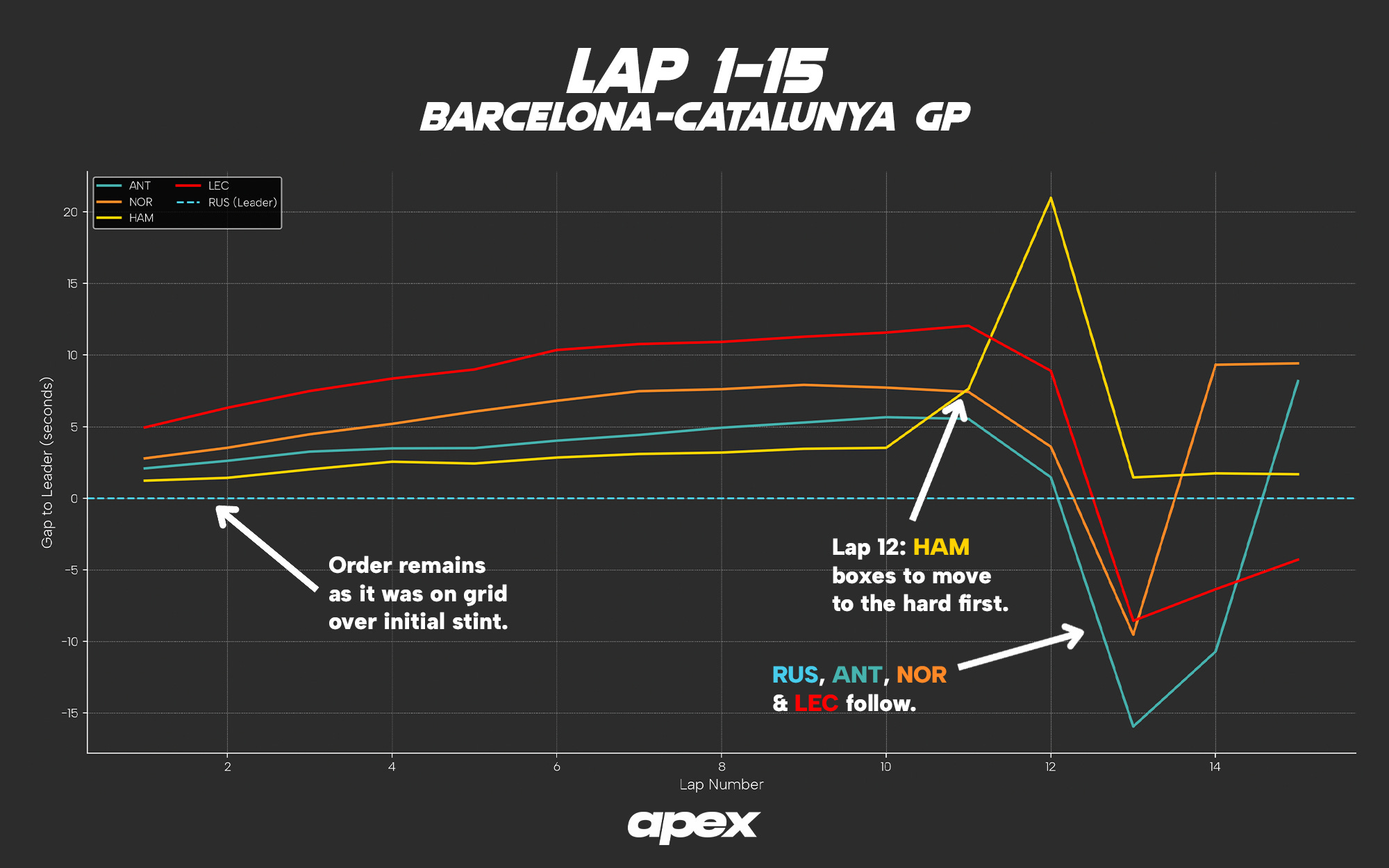
That second stint was more about management - all four of the top four drivers were split by less than three tenths per lap on average.
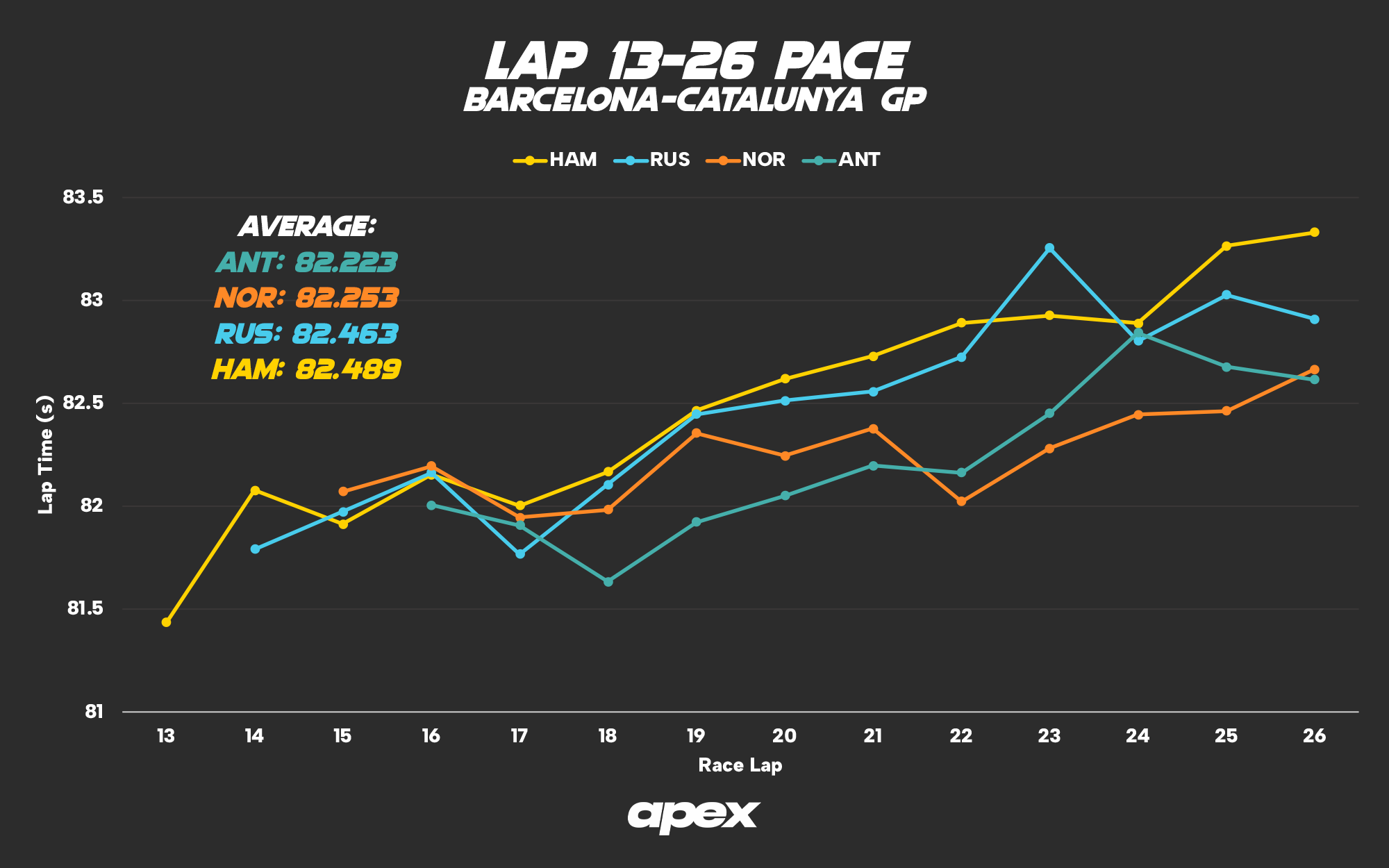
But Ferrari ended that stint on the hard early for Lewis, pushing him firmly into following the three-stop given that he boxed for mediums on lap 28. This stage of the race is where we saw the strategic split happen as Mercedes opted to leave their drivers out, following their planned two-stop.
As it turned out, this was one of the most formative parts of Lewis’ race.
His pace on the new medium was staggering: from laps 29 to 34 he was an average of 2.1s per lap quicker than Russell or Antonelli! Meanwhile, Mercedes’ decision fed directly into their two drivers being free to battle on their older hards, and as Toto Wolff spoke to post-race, that was influential in Hamilton’s ability to close down the gap not only to them, but inherently therefore the race lead too.
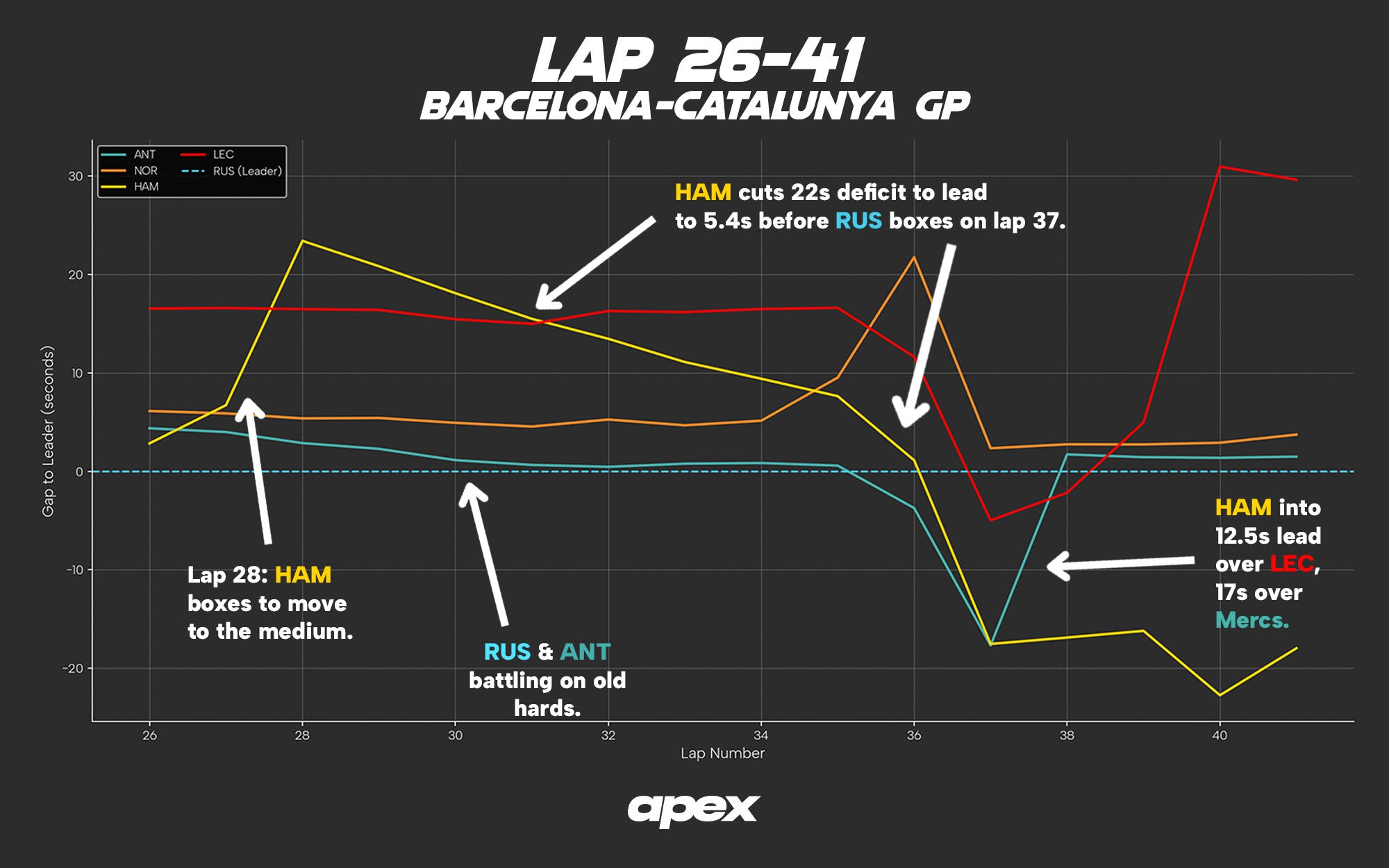
While Russell and Antonelli were within a second of each other until they followed Norris into the pits from lap 37 onwards, as they battled, Hamilton closed down his deficit to Russell’s lead from over 22 seconds to 5.4 seconds. It meant that after the two Mercedes and Norris had boxed, Lewis had created a huge 12.5 second lead over his own teammate Leclerc, or a 17 second net lead over the closest Mercedes of Russell.
The one pinch point of Ferrari’s plan was really the need for Lewis to stop one final time, given that he was on 10 lap old mediums at that point that simply could not do another 29 laps to the end from there.
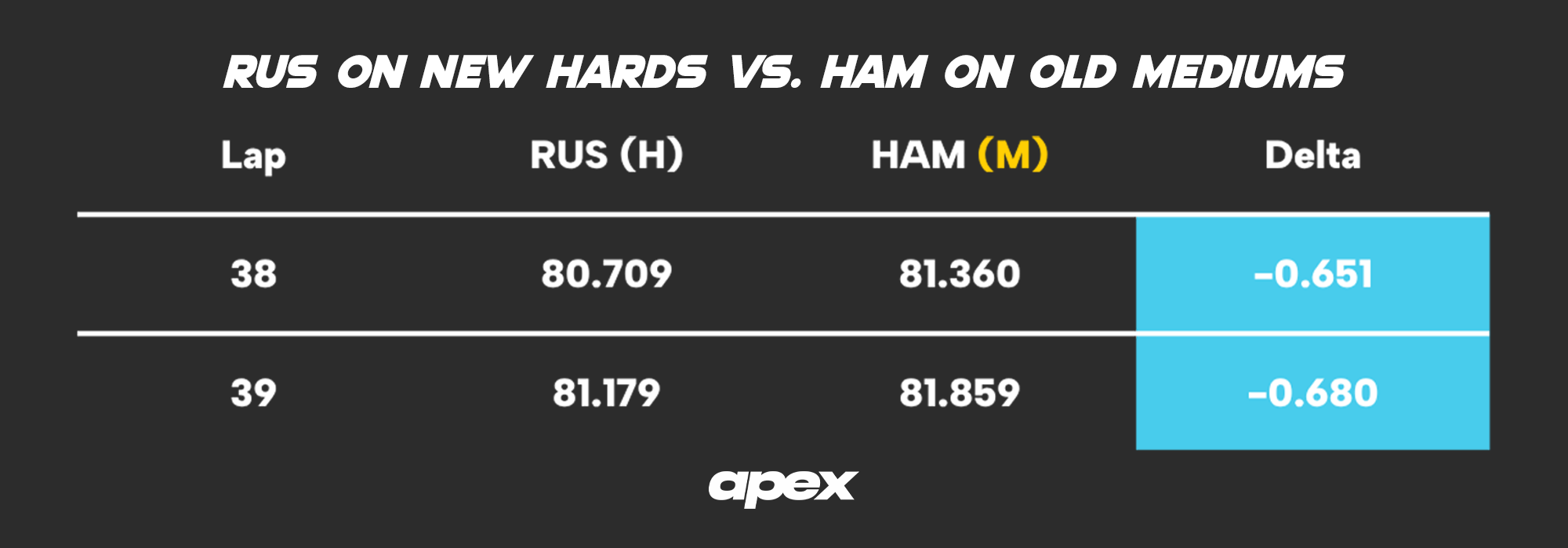
It meant his mission over the next few laps was to continue to extend the lead as far as possible and create a margin to box into, which was compromised slightly by the pace the Mercedes duo, and Russell especially, were displaying on the new hards. In fact, over the two laps after his stop, George was over 0.65s quicker per lap than Lewis.
However, the pinch point was pretty quickly and fortuitously resolved as Lewis’ old rival, Fernando Alonso, parked up on the grass with a battery issue triggering a yellow flag and then an all important VSC. That allowed Lewis to come in at the end of lap 41, take his third and final stop at a reduced cost, come out ahead of Russell by the control line with a <2s margin, and be on five lap younger hards for the remainder.
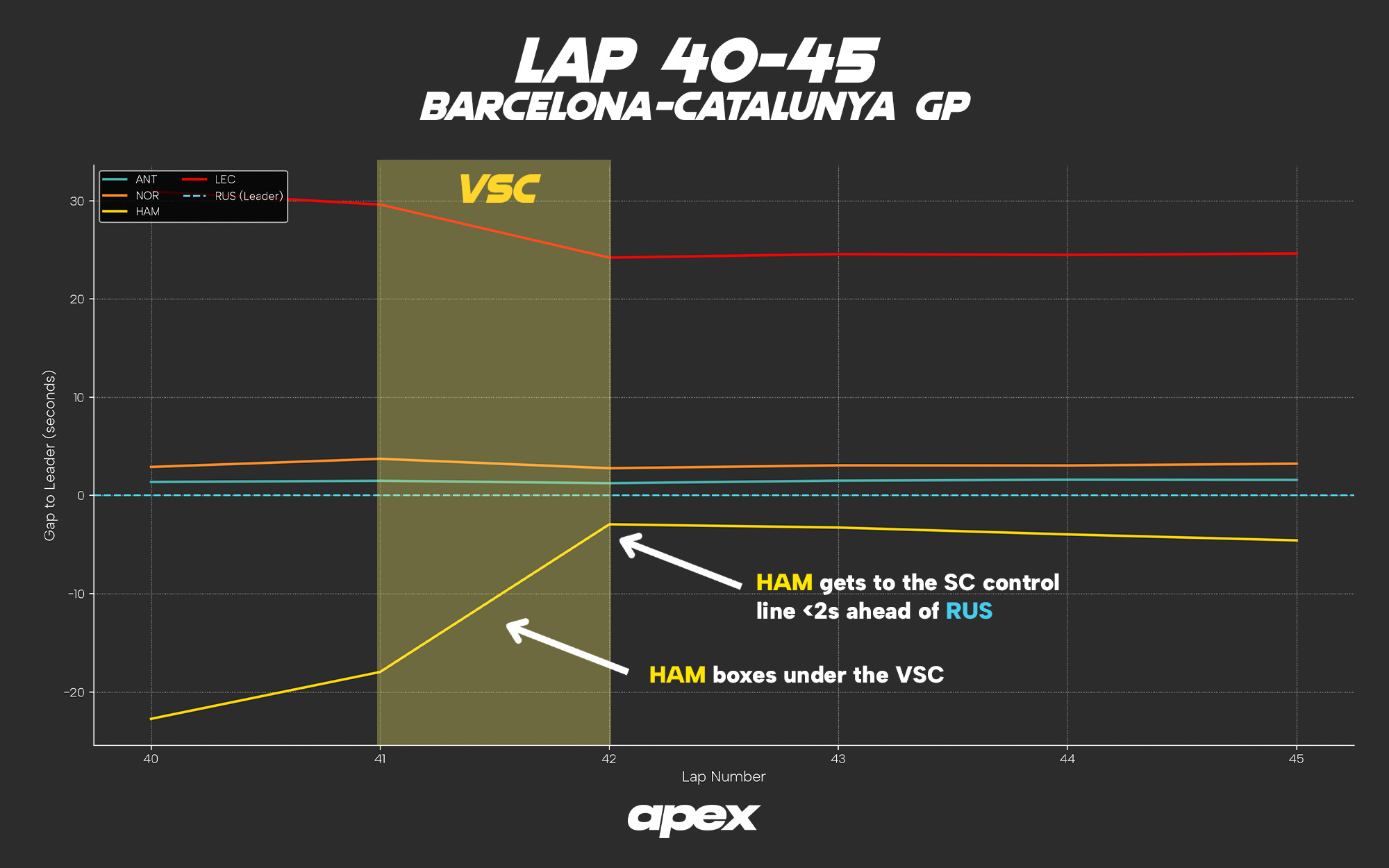
But that luck of the VSC timing has meant that the big question hanging over Lewis’ race is whether he could have won without it, and while we’ll never truly know, the gaps he had prior to its deployment and the pace he showed suggest it was likely.
Without the VSC?
If Lewis had boxed on lap 41 regardless of the VSC, and a stop would have had to come around that phase of the race given the pace drop off he was experiencing on the medium, he likely would have emerged after Norris or in P5 (based on gaps before VSC deployed on lap 40) but critically still with that 5-lap tyre life advantage over those ahead.
That, coupled with the pace he showed over the final stint as a result and there being 26 laps remaining point to there being a case for Lewis being able to fight back through to the lead.
And it’s important to look at that pace he showed post-green flag racing resumption, not only for that argument but also for understanding how central it was to him securing the victory as he did.
Sealing the deal…
Over the next phase, from lap 43 to 61 before the VSC was deployed for Antonelli’s stoppage, Lewis was an average of 0.835s quicker per lap than his closest rival for the lead in Russell. It’s pace that made the extension of his lead post-stop possible and prior to the VSC, it sat at 19.3 seconds from the under two it had been by that control line.
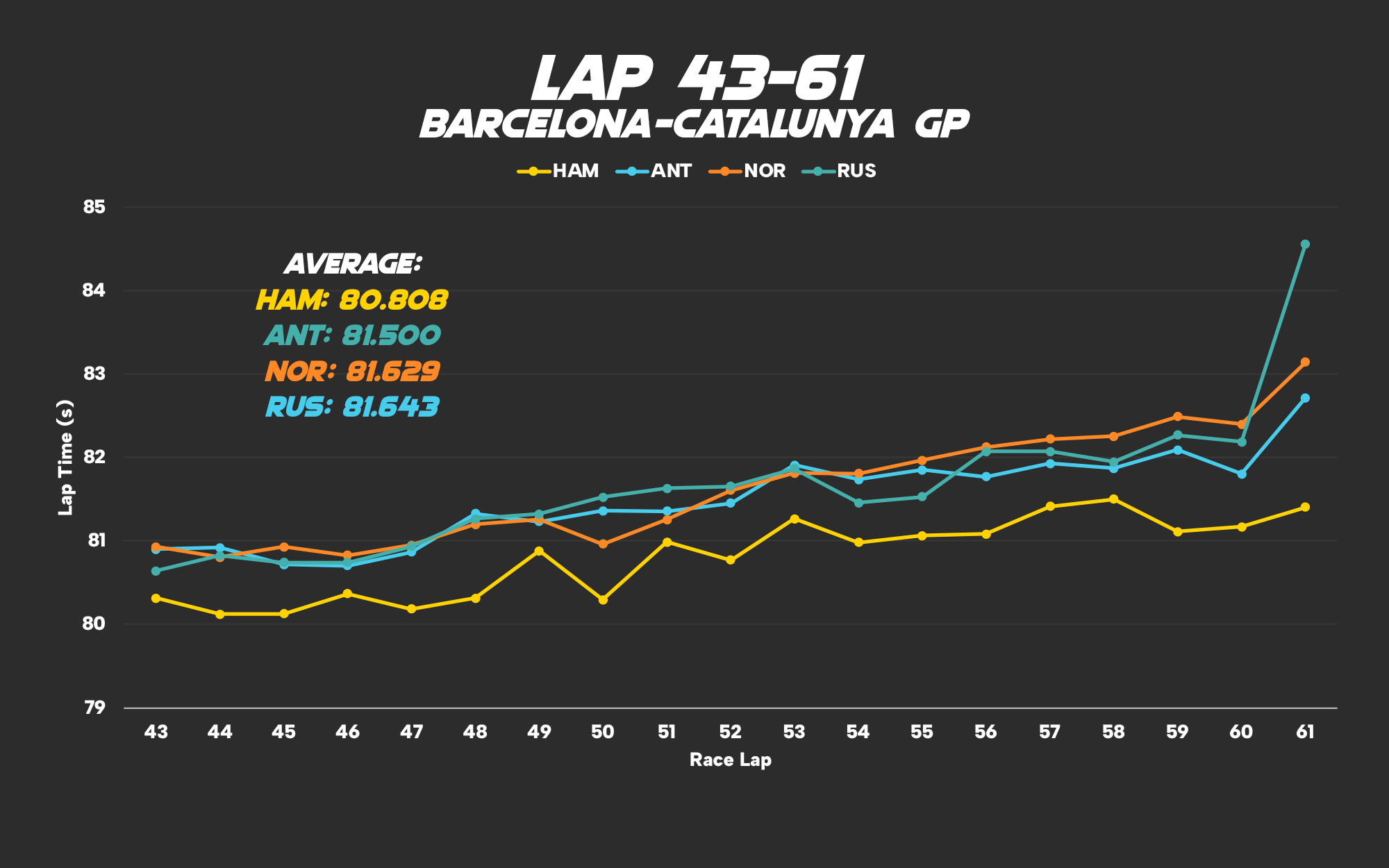
With two more racing laps at the end, Lewis saw the chequered flag a huge 19.5 seconds before George Russell, and 23.7 seconds before Lando Norris who rounded out the podium.
The Verdict
It’s a victory that in and of itself was a milestone one for Lewis, both personally and professionally, but it also had the feeling of being a milestone moment for the Lewis-Ferrari relationship.
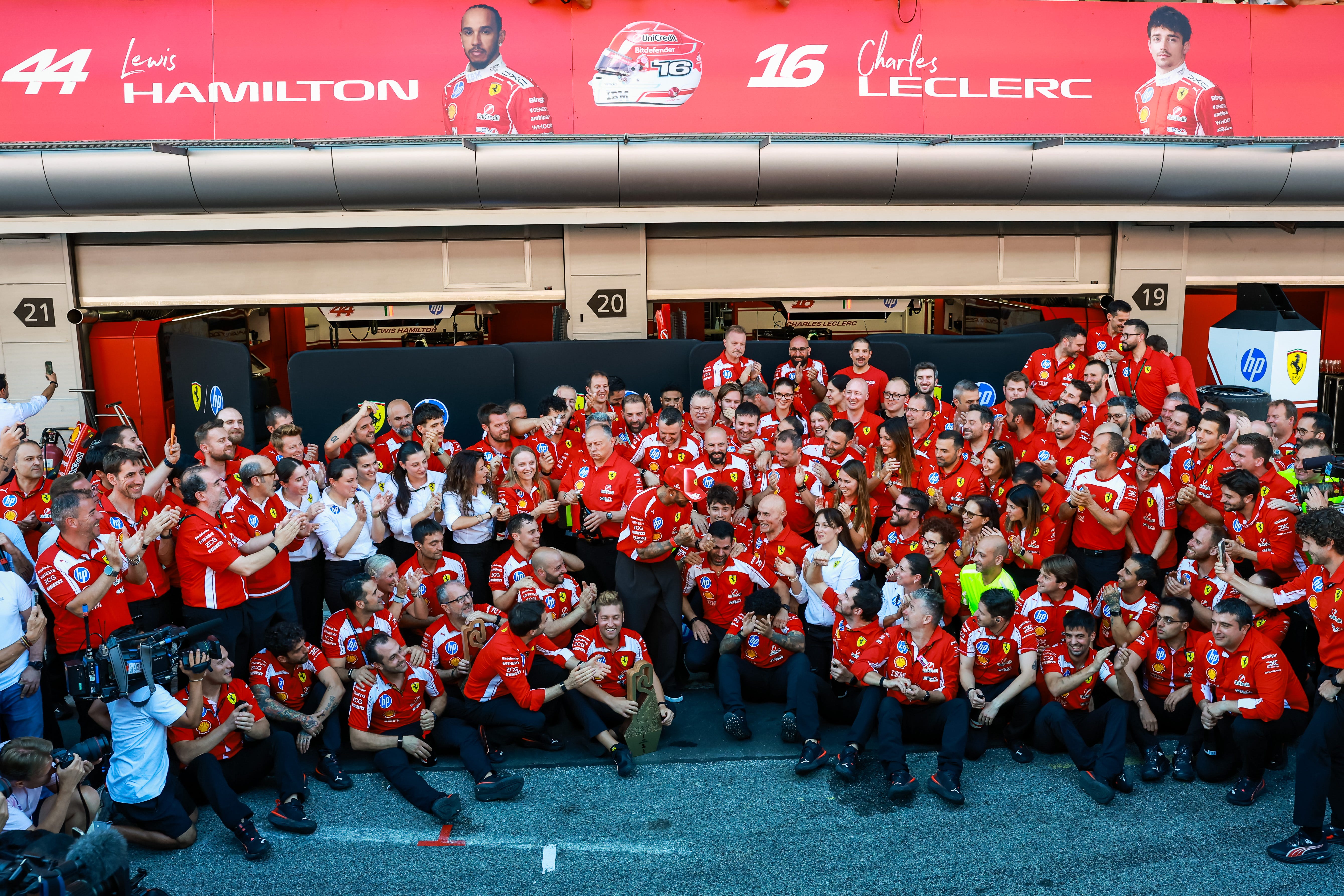
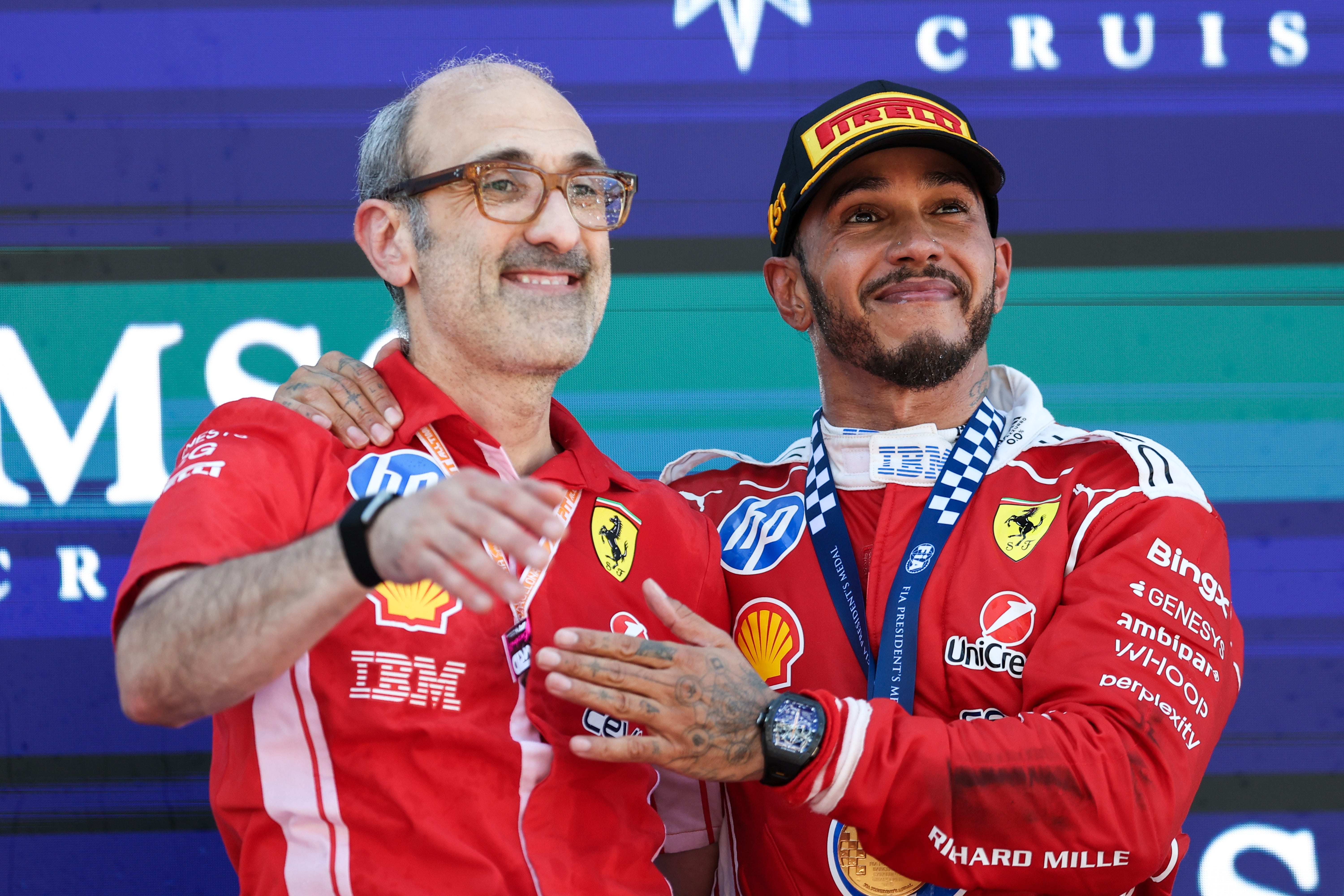
He spoke post-qualifying in Barcelona about his own comfort level and confidence, and I don’t think we can underestimate how vital and central that has been to his return to the top. Not only has that been on a personal level again, but also, and importantly, a professional one in how he’s embedded within the team and built his side of the garage around him.
It’s been building steadily and evidenced in the results he had leading up to this win and what he’s credited for those along the way, most notably in Canada where he finished P2 and praised the team for “moving mountains” for him to “enable this sort of performance” - a message he echoed yesterday.
And that references a few things: a change of brake setup that he requested from the team, their accommodation of his decision to move away from the simulator when preparing his weekends, a complete revamp of his engineering team including a new race engineer, Carlo Santi, and, at a more global level, influence over the design direction of their 2026 car and its development trajectory.
All of those have directly fed into that comfort and confidence for Lewis, but clearly have also had an impact on the team and how they look to be tackling races now - willing to take the aggressive approach, willing to make the strategic calls first, and able to put all the pieces together on a Sunday afternoon one-by-one to reap the rewards from the clearly strong car pace they have.
Making a win like this happen is a true team effort, as Fred Vasseur highlighted by saying, “if we are getting results it’s because collectively we are doing a good job”, and the real test of whether this is the sign of a permanent shift in how that collective works will come in Austria, Silverstone and then Belgium.