


As initially reported by AutoRacer.it, the FIA has issued a draft technical directive to the Formula 1 teams outlining how it will clamp down on flexible wings through alterations to the load tests.
The issue of flexibility in wings became a big topic of discussion over the 2024 season as it became apparent that McLaren and Mercedes had capitalised on this with their front wings, possibly from the early stages of the season – perhaps from Miami for McLaren and Monaco for Mercedes.
In fact, Mercedes had been open with the fact that they were seeking out flexibility, with technical director James Allison saying after the Monaco front wing upgrade provided a clear performance boost that “provided your wing is bending like a thing bends when it has load on it, then there’s no drama to be faced with the governing body”.
Even so, this prompted Red Bull and Ferrari to seek clarification over their legality from the FIA, and a delay in this answer frustrated Ferrari team principal Fred Vasseur, who post-season spoke to it being an area of “clear performance” that they had to wait to exploit themselves.
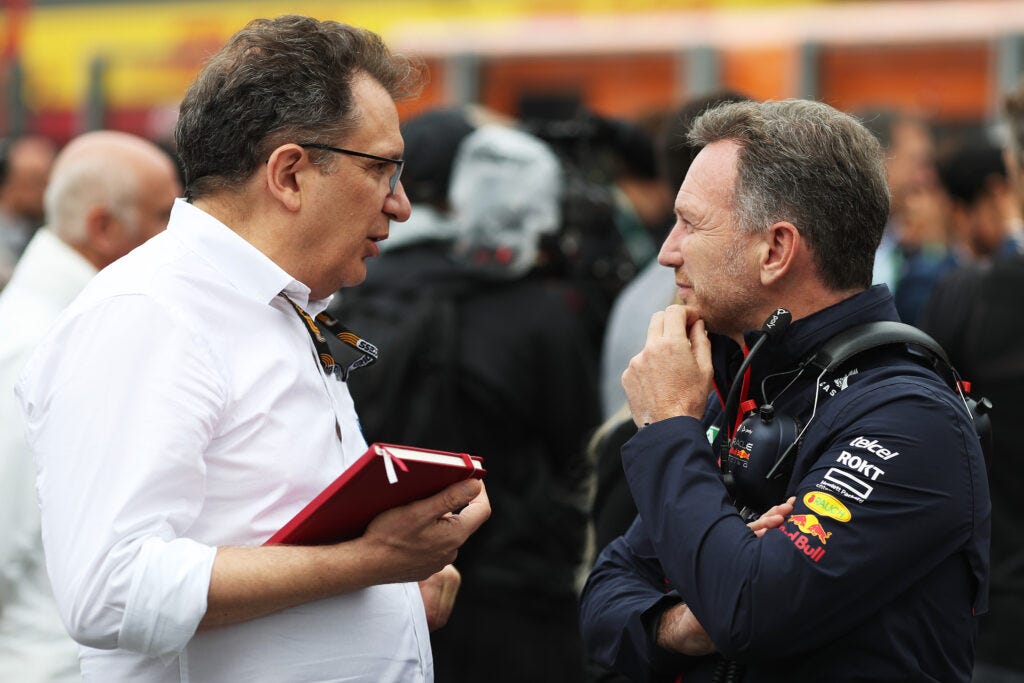
The FIA’s official stance at the end of the 2024 season was that no changes would be made to the front wing load tests ahead of the 2025 season, with Nikolas Tombazis, head of single seaters at the FIA, citing challenges in assessing the front wing flexibility as reason for not introducing new tests.
“We are pretty happy with what we’ve seen,” Tombazis told Autosport. “I hasten to say that it’s not a question always of being happy or not. It’s also a question of whether you feel that a meaningful test can be made.
“One of the challenges in the front wing is that, compared to other parts of the car, the front wing loading is much more varied between cars in a given location and so on.
“So most tests relate to the load of a certain direction, certain position of application, certain magnitude must not produce a [certain] deformation.
“The most successful such tests imitate as much as possible what happens in real life with loads and, on the earlier wing for example, it’s reasonably successful. On the front wing, the variety between cars would make that quite difficult.”
However, a report from AutoRacer.it has suggested that the FIA intend to implement a new technical directive in June of this year to refine the tests conducted for front wings in particular, with the scope of the rear wing tests also increasing but from the first race – representing a u-turn of sorts.
Let’s deep dive into what flexi wings are, why the FIA are clamping down, and what the potential effects might be…
Why have flexible wings & how do they work?
In the era of stiff, ground effect cars, any element of flexibility may not only offer a performance benefit but also benefit the balance of the cars which has been a struggle for the teams since 2022.
